I Left with more than I could carry
- installation and performative speech by Liza Madi
Wednesday, 24 June, 7.00 pm, Kaliska 8/10
Through an exhibition and performance speech, visual artist Liza Madi shares her experience of living through war in Gaza and the ways art became a tool for remembering, resisting disappearance, and carrying fragments of home across borders.
Liza Madi is a visual artist, interior designer. Her interdisciplinary practice moves between contemporary art, spatial practice, and interior design, drawing on personal experiences of displacement, instability, and life within fragile environments.
Working across different media, Madi investigates the relationships between memory, space, identity, and belonging. Her work explores how personal and collective experiences become embedded within places, objects, and spatial environments, and how disruption, loss, and transformation reshape emotional connections to home and community.
Through research-based and experiential approaches, she examines liminal and transitional spaces, traces of absence, adaptation, and the psychological dimensions of environments affected by crisis. Personal archives, everyday materials, and ordinary remnants often become central elements in her work. She creates artworks that evoke uncertainty, and resilience.
Madi participated in numerous group exhibitions and artistic initiatives across the world, including presentations within the Gaza Biennale pavilions (2024–2025). She is currently an artist-in-residence at Ujazdowski Castle Centre for Contemporary Art (2025–2026), where she develops research-driven and experimental projects that connect lived experience, spatial thinking, and contemporary art practice.
A screening of films by Basma al-Sharif
25th, 8pm, Kaliska 8/10 Street
UNSEEN presents an impressive session with four works by Basma al-Sharif, a Palestinian artist working between cinema and installation.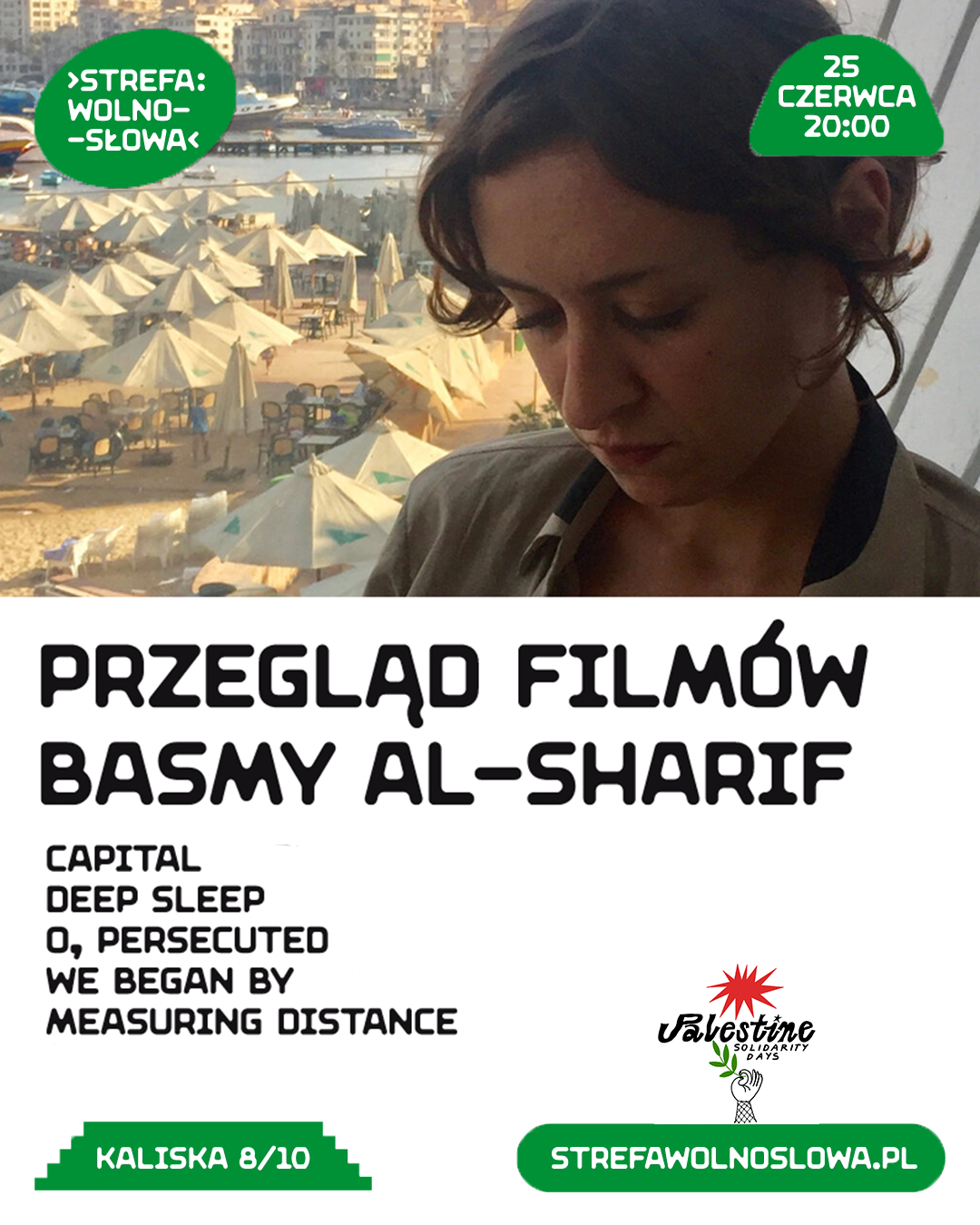
Born in Kuwait in 1983 to Palestinian parents, she grew up in France and the United States, traveling on a US passport. She cannot enter the country of her parents, nor the land where her grandparents live. Her practice looks at cyclical political conflicts and confronts the legacy of colonialism through satirical, immersive, and lyrical works.
We will screen:
Deep Sleep – Made while restricted from travel to Gaza. Autohypnosis as a method to bi-locate into multiple places. A year’s worth of sessions recorded onto Super8mm. Movement through ruins of ancient civilizations embedded in modern civilization-in-ruins.
O, Persecuted – Restoring Kassem Hawal’s 1974 Palestinian Militant film Our Small Houses into a performance possible only through film. Speed, bodies, past moving into a future that collides ideology with escapism.
We Began By Measuring Distance – Long still frames, text, sound. An anonymous group measures distance. Innocent measurements turn political. An ultimate disenchantment with facts when the visual fails to communicate the tragic.
Capital – Egypt sinks into poverty and debt. New cities rise. Prisons fill. A ventriloquist, songs, advertisements describe a bygone fascism. Satire as the only safe language.
“I have not decided to represent anyone but myself, although this me is full of collective memory.”
Come experience the urgency of Palestinian cinema and join the discussion.
Curators: Natalia Lis and Pavel Tavares
Theatre as an act of resistance –
a conversation with Marina Barham
Friday, 26 June, 7.00 pm, Kaliska 8/10
The space of Strefa WolnoSłowa will be open from 6.00 pm – before the event, you will be able to experience the sound installation entitled “Stories from Gaza”, created by artists from the Al-Harah Theatre.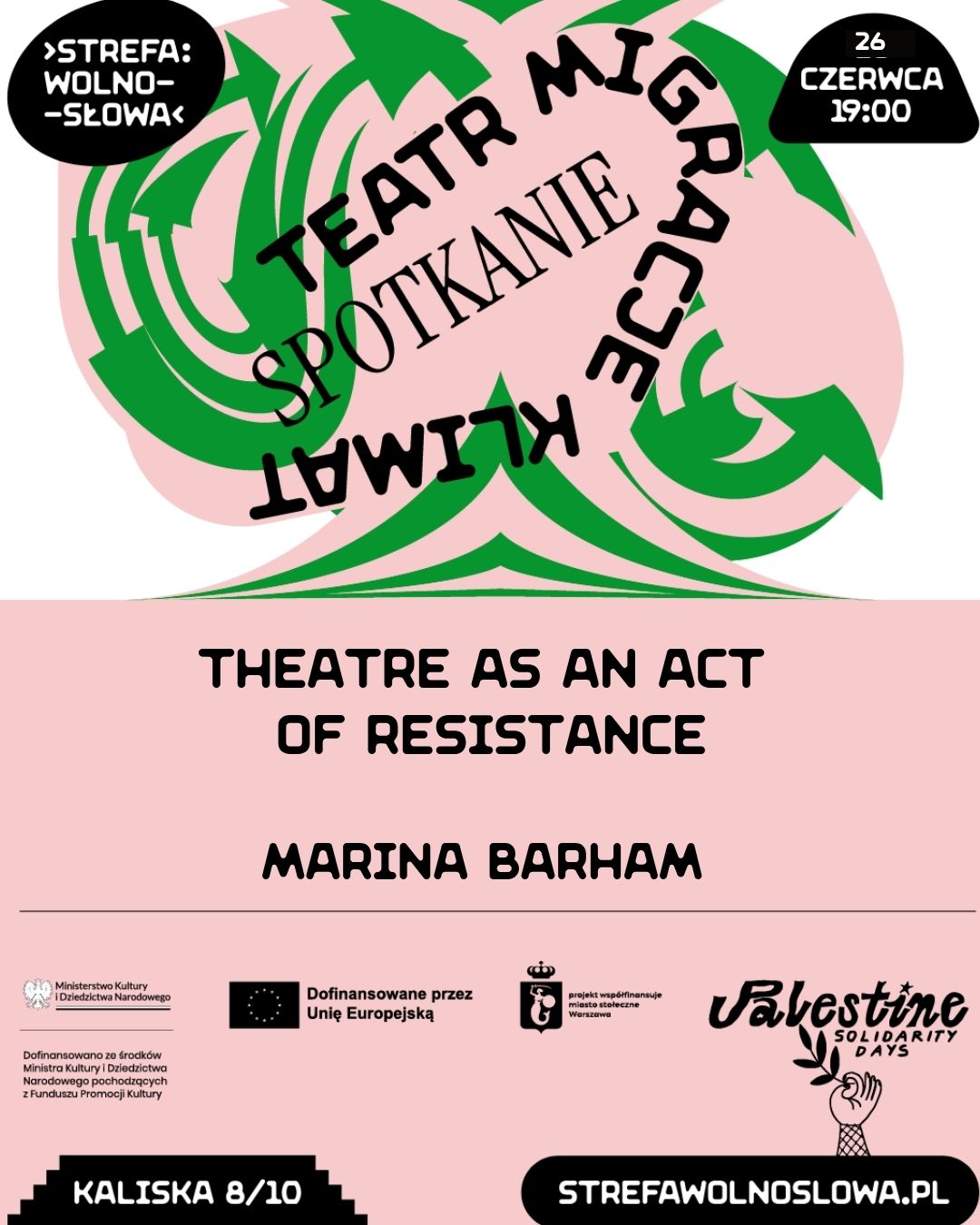
What role does theatre play in Palestine today? Whilst genocide is taking place in Gaza, daily life in the West Bank is marked by occupation, violence, displacement and constant uncertainty. Theatre therefore goes far beyond mere artistic expression – it becomes an act of emotional resistance. Whilst people, land and the environment are being destroyed, theatre seeks to nurture memory, community and hope.
Marina Barham, director of Al-Harah Theatre, founded in 2005 in Beit Jala, near Bethlehem, will speak about the situation of theatres and artists in Palestine today, and about her theatre’s experiences.
Through a unique model combining theatre activities with psychosocial support, Al-Harah transforms school classrooms and community centres into safe spaces for empowerment and emotional release. The theatre’s programmes help children cope with trauma, rediscover joy and rebuild their self-esteem. At the heart of Al-Harah’s philosophy lies the belief that art can heal, liberate and restore hope. It is this idea that shapes all areas of the theatre’s work.
The event will be interpreted from English into Polish.
Colophone
The meeting with Marina Barham is part of the ‘Archive of Abuses’ project, co-funded by the Minister of Culture and National Heritage from the Culture Promotion Fund – a state-funded special-purpose fund
DKF UNSEEN is part of the project “Centre for Cultural and Artistic Activities of Strefa WolnoSłowa – Kaliska 8/10”, funded by the City of Warsaw.